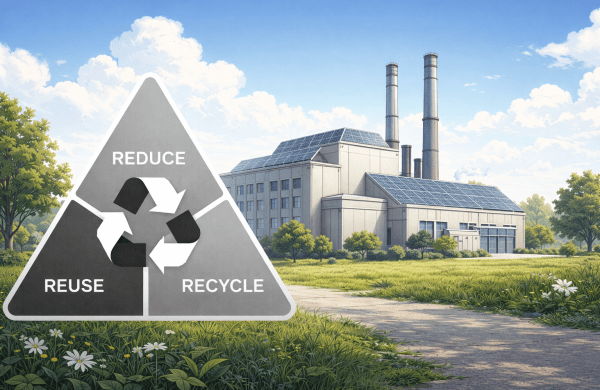
As digital infrastructure is being pressured to come online faster, more sustainably, and with more technological innovation in design, choosing to not break new ground through adaptive reuse is indeed a groundbreaking solution. It offers a pathway to not only preserve our environment but also to foster cutting-edge advancements in technology.
Adaptive reuse refers to the process of repurposing existing structures for new uses rather than constructing a site from the ground up. This practice is not only environmentally beneficial, reducing waste and conserving resources, but also economically advantageous. We can also accelerate our project timelines to deploy high density racks and AI applications within months.
Environmental Impact
One of the most significant benefits of adaptive reuse is its positive impact on the environment. Both traditional demolition and new construction generate substantial amounts of waste and consume vast quantities of natural resources. Building new data centers often involves extensive land use, energy consumption, and material sourcing. By contrast, repurposing existing structures minimizes these environmental footprints.
Adaptive reuse significantly lowers embodied emissions, especially those related to Scope 3 emissions, which include all indirect emissions that occur in the value chain. By embracing a circular economy approach, adaptive reuse eliminates the need for new materials, thus avoiding the initial carbon footprint and approximately 80% of emissions associated with the production of concrete and other construction materials. This practice allows for immediate sustainable impact on day one by utilizing existing mechanical and electrical systems already present in the facilities.
Technological Advancements
Adaptive reuse doesn’t mean compromising on technological capabilities. Modern engineering techniques allow us to retrofit old buildings with state-of-the-art technologies that meet or even exceed current standards. For instance, integrating advanced cooling systems, renewable energy sources, and building for AI and HPC can transform an industrial facility into a high-efficiency data center, providing unique opportunities for innovation. Engineers and architects must creatively solve challenges posed by existing structures, leading to novel solutions that might not emerge in traditional construction projects.
- Advanced Cooling Systems: One of the critical technological upgrades in adaptive reuse projects is the implementation of advanced cooling systems. These systems are crucial for data centers to maintain optimal operating temperatures and improve energy efficiency. By advancing our cooling techniques as we grow an adaptive reuse facility, we can apply the most efficient and cost-effective cooling application to the unique needs of the hall and its tenants.
- Scalability and Flexibility: Existing buildings retrofitted for new uses often need to accommodate future growth and technological changes. Adaptive reuse encourages the creation of designs that can be easily expanded or reconfigured as technology evolves. The scalability we are building in to each site as we add new halls keeps them at the peak of design innovation as well as highly efficient, providing a better return on investment as we grow.
- Improved Resilience: Upgrading older buildings to meet modern standards often includes enhancing their resilience against environmental and physical threats. This has involved reinforcing structural elements, installing advanced security systems, and making our sites more robust and resilient.
Adaptive reuse stands out as the data center game changer we’ve all been waiting for—a solution that harmonizes technological advancement with environmental stewardship. By repurposing existing industrial sites into high-performance data centers, we have significantly reduced our environmental footprint while pushing the boundaries of innovation.
As we move forward into an increasingly digital world, embracing adaptive reuse will be crucial for achieving sustainable growth without sacrificing progress or time to market. It’s time we rethink our approach to development and work towards a greener future through innovative measures to make obsolete structures into the advanced digital infrastructure we are tasked with delivering.